General Information
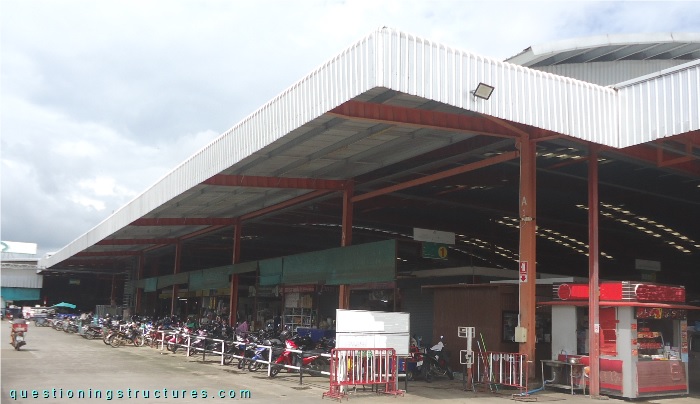
Figure 1 shows a steel canopy roof.
Trapezoidal Corrugated Web Beams
Figure 2 shows a structure sector.
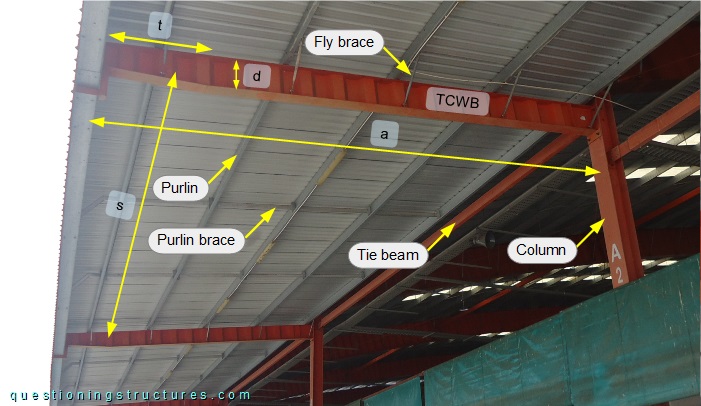
The steel structure consists mainly of columns, tie beams (between the columns), trapezoidal corrugated web beams (TCWB) with a slightly tapered free end region (t), purlins, purlin braces, fly braces, and metal roofing sheets with a bullnose front edge. The columns are made of H-sections, the tie beams are made of rectangular hollow sections, the purlins and their braces are made of C-channels, and the fly braces are made of circular hollow sections with flattened ends. The cantilever arm a ≅ 5.5 m, the TCWB depth d ≅ 0.5 m, and the spacing s ≅ 12 m. Figure 3 shows a canopy roof sector.
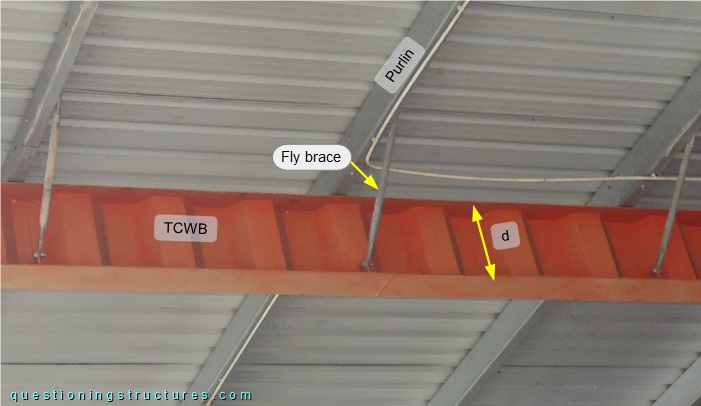
When are fly braces required for TCWB?
Figure 4 shows a schematic three-dimensional view of nine steel sections and a two-dimensional structural model.
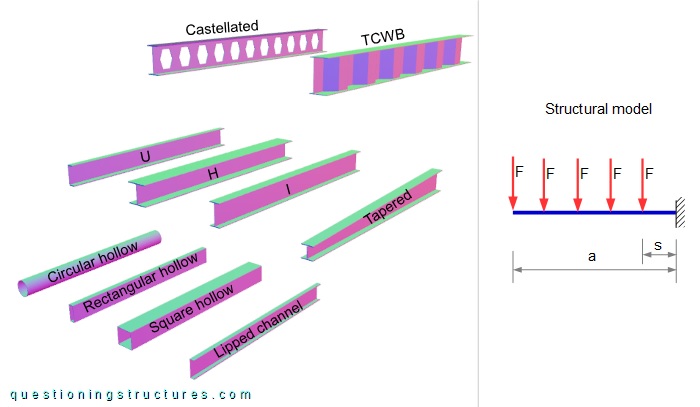
The sections are of type castellated with hexagonal openings, TCWB, U, H, I, tapered, circular hollow, rectangular hollow, and square hollow. The structural model consists of an unbraced cantilever beam with five forces (F) placed at a constant spacing (s).
If all information is available, can one of those sections ever meet all factors?
Connection Between TCWB and Column
Figure 5 shows the connection between the TCWB and the column.
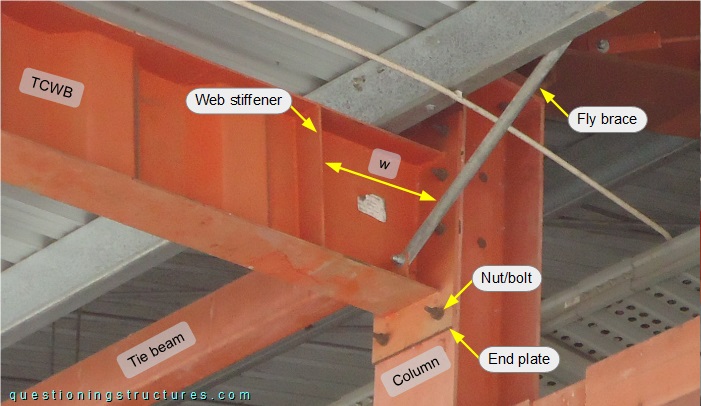
The connection consists of an end plate (approximately the same thickness as the column's flange) and eight bolts/nuts (4 x 2). The first web sector (w) is flat and terminated with a web stiffener; a fly brace pair is installed in proximity to the column.
What are some possible reasons to install fly braces in proximity to the column?
Steel column web stiffeners are not installed. When are they required?