General Information
Figure 1 shows a covered sports court.
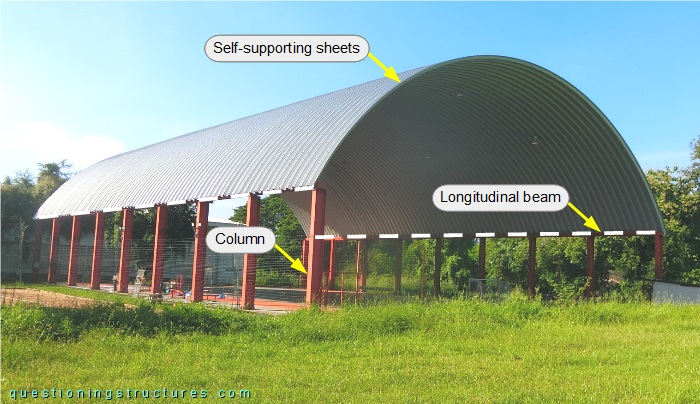
The steel structure consists mainly of self-supporting curved sheets, two longitudinal beams, and columns.
Self-Supporting/Trussless Curved Roofing
Figure 2 shows a front view of the structure.
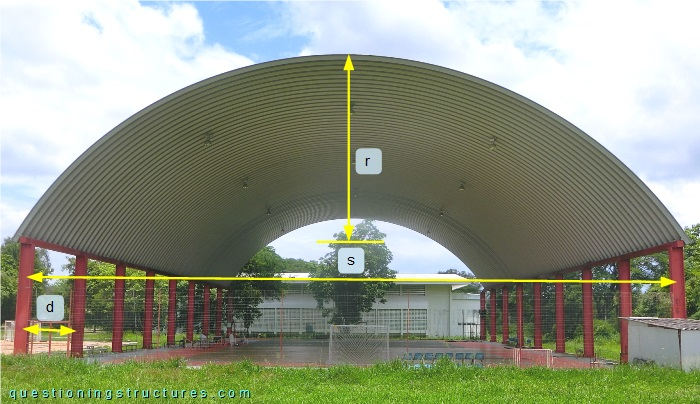
The span s ≅ 30 m, the rise r ≅ 8 m, and the column spacing d ≅ 5 m. Figure 3 shows a structure sector.
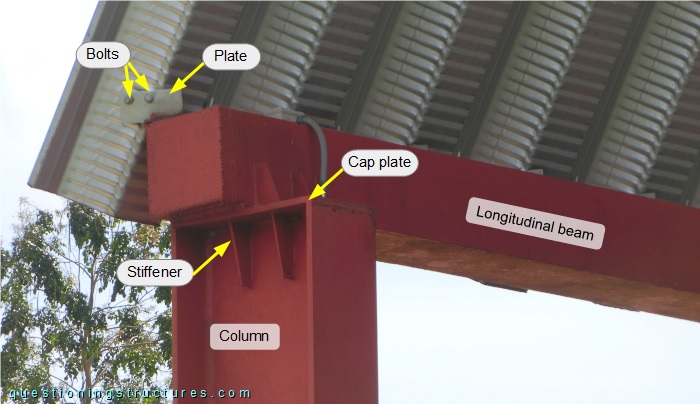
The sheets have a thickness of about 1.5 mm, and the longitudinal beam has a square hollow cross-section (built-up section). The sheets and the longitudinal beam are connected by steel plates, which are bolted to the sheets and welded to the longitudinal beam. The connection between the column and the longitudinal beam consists of a stiffened cap plate (weld connection). Figure 4 shows a roof sector viewed from below.
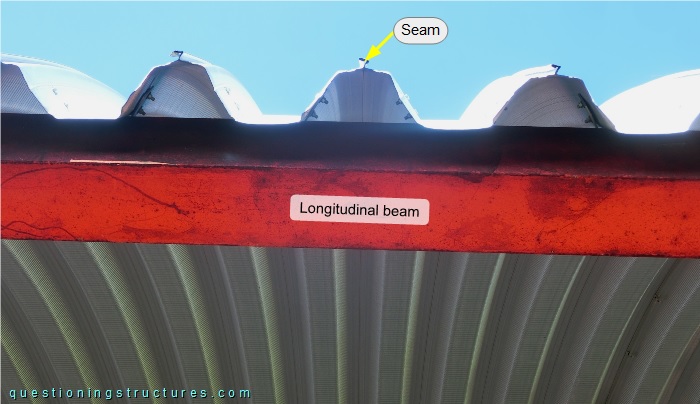
The sheets are connected by mechanical seaming.
What are the main pros and cons of self-supporting/trusless curved roofing?