General Information

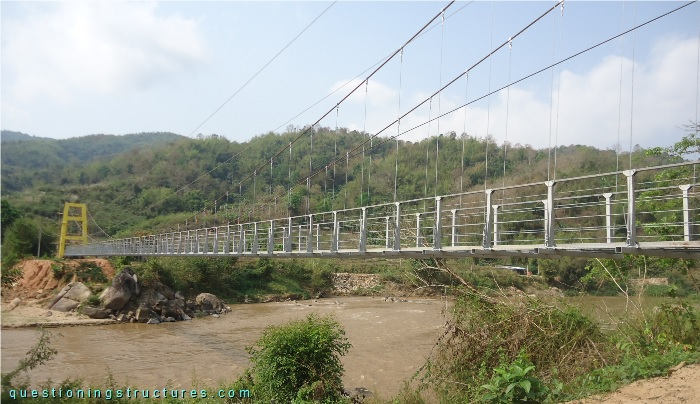
Figure 1 shows a pedestrian suspension bridge.
Suspension bridge.
Single-span suspension over a river
Type Single-span suspension bridge
Main span ≅ 80 m
Deck width ≅ 1.5 m
Deck width to main span ratio ≅ 1:53
Pylon Reinforced concrete
Girder Steel transverse beam

Main Cable Anchorage

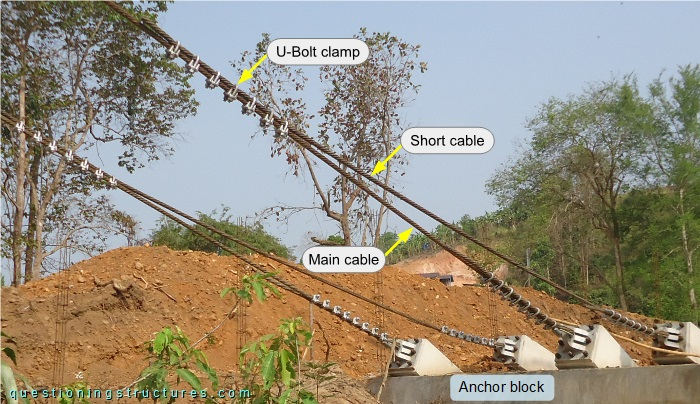
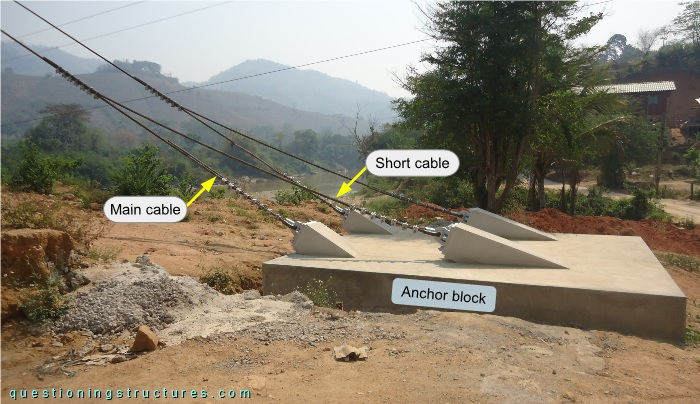
Figure 2 shows an anchorage.
Main cable anchorage.
Main cable anchorage of a single-span suspension bridge

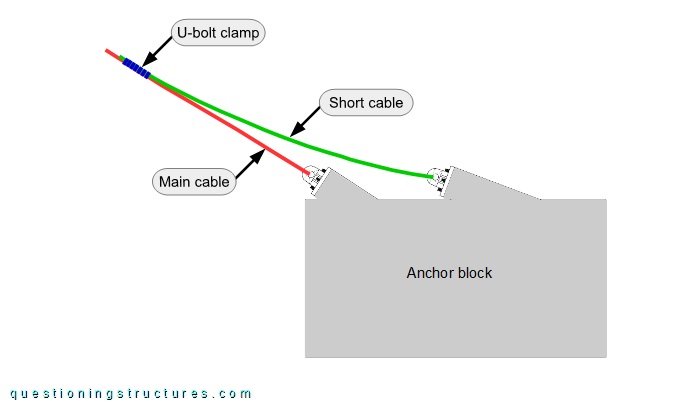
The two main cables are connected to the front region of the anchor block; two short cables (same type and size as the main cables) are connected to the mid-region of the anchor block and the main cables. Figure 3 shows the connection between the main and the short cables.

Main cable to short cable connection.
Main cable anchorage of a single-span suspension bridge

The two cables are overlapped and fixed with U-bolt clamps.

  • What is the purpose of the short cables?
  • Deck

    Figure 4 shows the deck.

    Suspension bridge deck.
    Suspension bridge with expanded steel grating

    Over the girders are placed pre-assembled units (red shown) and lateral stringers (LS); the latter are made of rectangular hollow sections. A unit is supported by two girders, while a lateral stringers (LS) is supported by four girders. The units are connected by horizontal bolting and consist of expanded steel gratings (deck), stringers, and floor beams. Figure 5 shows the units before installation.

    Pre-assembled units.
     Pre-assembled deck units of a single-span suspension bridge

    There are three stingers (1 to 3) and eight floor beams (two external and six internal). Stringers 1 and 3 are made of L-sections, while stringer 2 is made of an L-section and a rectangular hollow section (yellow dashed lines) connected over it; the floor beams are made of rectangular hollow sections. Figure 6 shows a schematic cross-section of the bridge and a non-pre-assembled variant.

    Cross-sections.
    Suspension bridge cross-sections showing two different deck systems

    The variant consists of three stringers made of rectangular hollow sections and steel grating deck.

  • What are some possible reasons to choose the pre-assembled variant?
    Suppose a hardwood deck instead of a steel grating deck. What are the main structural and constructive differences? What are the main pros and cons?
  • Safety Barrier

    Figure 7 shows the bridge.

    Suspension bridge.
    Safety barrier with posts and cables of a single-span suspension bridge

    The safety barrier consists of posts made of rectangular hollow sections, tapered post stiffeners (two per post), handrails, and cables, which are anchored to the pylons. Figure 8 shows a schematic cross-section of the bridge and a safety mash barrier variant.

    Cross-sections.
    Suspension bridge cross-sections showing two different safety barrier systems
  • Does the barrier system affect the structural behavior of the above shown bridge?
    Which is the barrier system that probably uses fewer resources?
    What are some possible reasons to choose the post-cable system instead of the mesh system?
  • Bottom Cables

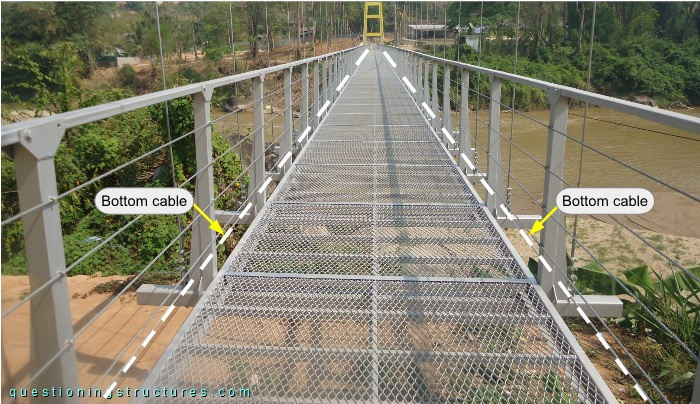
    Figure 9 shows the main span.

    Suspension bridge with bottom cables.
    Suspension bridge with two bottom cables

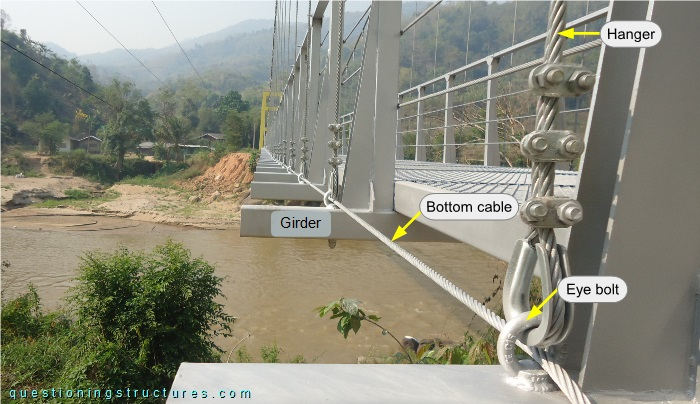
    There are two bottom cables; they run horizontally between the girders and are anchored to the pylons. Figure 10 shows a bottom cable.

    Bottom cable.
    Connection between bottom cable and girder of a suspension bridge

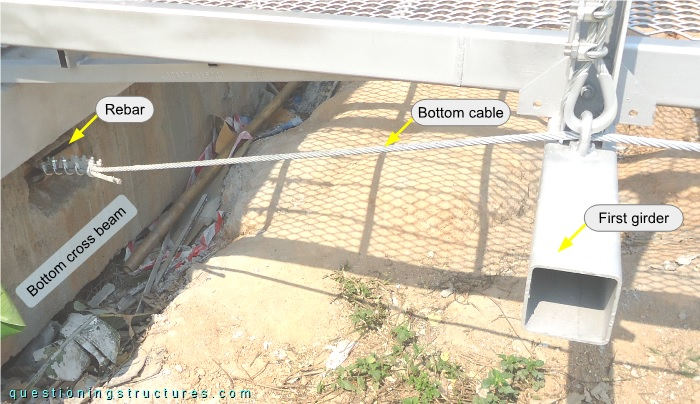
    The bottom cable passes through the holes of the eye bolts used for the hanger-to-girder connection. The pylon anchorage is shown in figure 11.

    Bottom cable anchorage at the pylon.
    Bottom cable anchorage at the pylon

    The bottom cable is vertically and horizontally deviated at the first girder and connected to horizontal rebars of the pylon's bottom cross beam. The bottom cable termination consists of a cable thimble and U-bolt clamps.

  • What is the purpose of the bottom cables?